
Martin Chemnitz, known as "The Second Martin" was the leader of the second-generation Lutherans in Germany after Luther's death. Roman Catholic leaders at the time are rumored to have uttered the phrase, "If the second Martin had not come, the first Martin would not have stood." And that very well may be true. Chemnitz upheld Reformation teachings at a time when the papacy was trying to stifle it out.
In order to address Reformation ideas, the Roman Catholic Church called the Council of Trent, which took place from 1545-1563. This is seen as the largest event of the Counter-Reformation. Trent was basically a big "NO" to Reformation theology. In response to this Council that anathematized evangelicalism, Martin Chemnitz wrote a four-volume Examination of the Council of Trent.
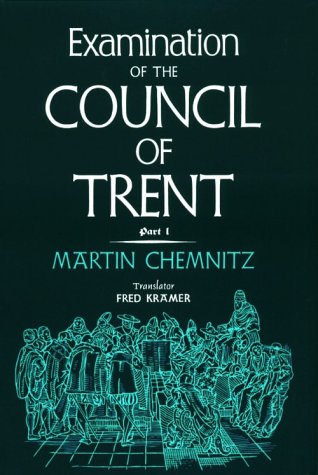 In this brilliant work, Chemnitz explains why each of the false statements that Rome decreed at the Council are unbiblical and should be overturned. It is a text that is still used in Protestantism today.
One issue that was around during the Reformation was communion under both kinds. At this time, Rome withheld the communion wine from the laity. They said that the laity could partake of the bread, but Jesus' blood was reserved for the priests and bishops. This deliberate withholding of a gift Christ freely gave to his whole church infuriated many reformers and even some Catholics. And the Council of Trent did nothing but uphold this tradition, decreeing that under no circumstances is the cup to be administered to laymen, since it does not belong to them, but only to the clergy.
Luther addressed this in his 1520 treatise, The Babylonian Captivity of the Church, and Chemnitz devoted one hundred pages to it in his Examination of the Council of Trent.
Sadly, this denial of the blood of Christ to Christians just because they are not priests is still practiced in some diocese of the Catholic Church today. In this way, the Council of Trent's legacy still lives. But Martin Chemnitz remains a hero. His Examination, Loci Theologici, and of course the timeless Solid Declaration of the Formula of Concord are true treasures of the Church today. And a paper about this great man was a fine way to finish up my academic semester.

Thanks again for sharing your work...can't wait to read the paper...I am interested in know what type of scriptural defense the papacy would use to claim that the only the clergy should be given the blood and not include the laity.
ReplyDeleteI just sent it to ya. Hope you enjoy it :)
Delete